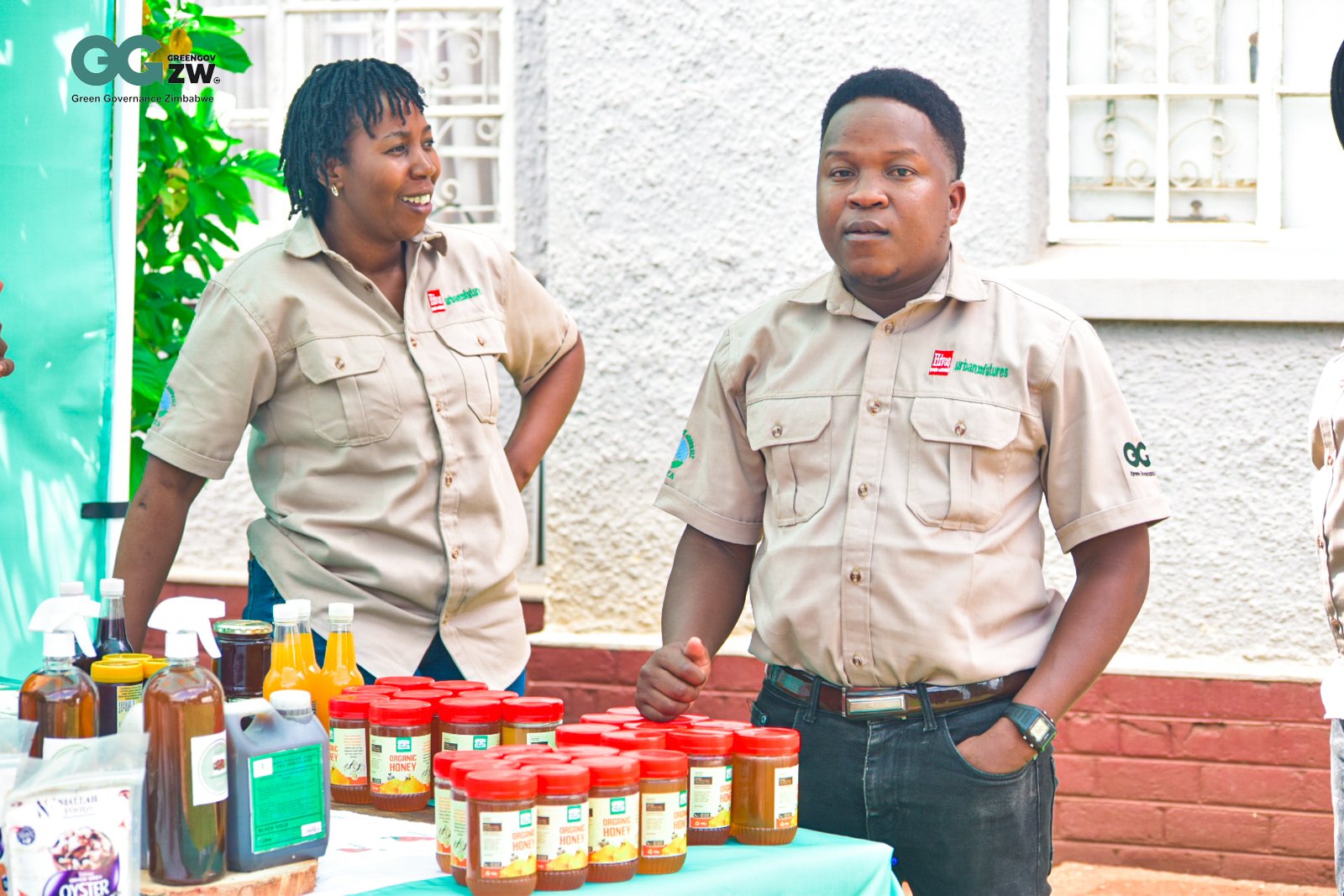
In Zhanje Village in Dema on the outskirts of Harare, the future of farming is being reimagined in small spaces, not vast commercial fields, but homesteads, backyards and shared community plots.
For many of the young farmers in the Seeds of Change project, agriculture once felt distant. Limited access to land and water meant traditional farming models were out of reach.
Rather than wait for ideal conditions, they chose adaptation. Using agroecology, a farming approach built on local knowledge, biodiversity and low external inputs, they began cultivating what they could, where they could, turning constraints into a strategy for climate resilience.
Only a small proportion of youth farmers initially had access to land or reliable water sources. Yet these constraints became the foundation of innovation. By decentralising production, the group demonstrated that sustainable farming does not depend solely on scale, but on systems that work within local realities.
The Seeds of Change initiative project, implemented in Zimbabwe by the Food Justice Network (FJN) and led globally by the Youth in Agroecology and Restoration Network (YARN), is strengthening youth participation in sustainable agriculture through a combination of practical training, community engagement, enterprise development, movement-building and policy engagement. Rolled out in August 2025, the programme aims to equip young people with skills and opportunities that support agroecology and long-term food system transformation.
Its ambition goes beyond production. It seeks to position young people and smallholder farmers at the centre of food system transformation while opening pathways into what are increasingly recognised as green jobs, livelihoods that contribute to environmental sustainability and climate adaptation.
Central to the initiative is the view that collective action is necessary for food systems transformation, with young people identified as key agents of change.
However, Food Justice Network Coordinator Roselilly Ushewokunze says that food systems actors, particularly youth and women, are often underrepresented in policy discussions that shape food systems priorities. Limited access to technical skills required to implement agroecological practices is also cited as a factor restricting broader adoption and policy integration.
“Food systems transformation requires a holistic approach to transform both policy and practice. Whilst frontliners work tirelessly to transform practice, this must be supported by enabling policies,” she said.
“In our work as FJN, we have observed that young people are often observers rather than key stakeholders in policy making and resource sharing. However, true transformation requires that young people participate meaningfully in policy and decision-making.”
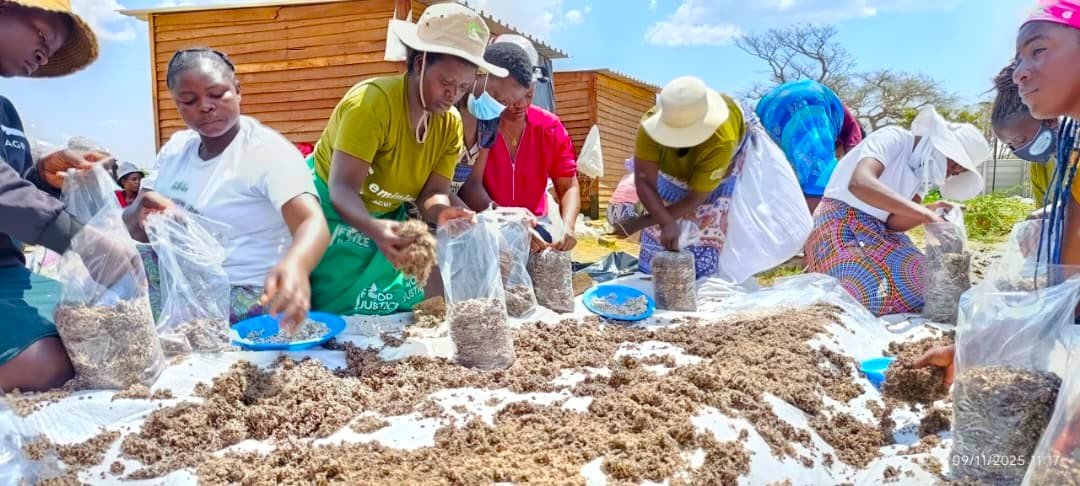
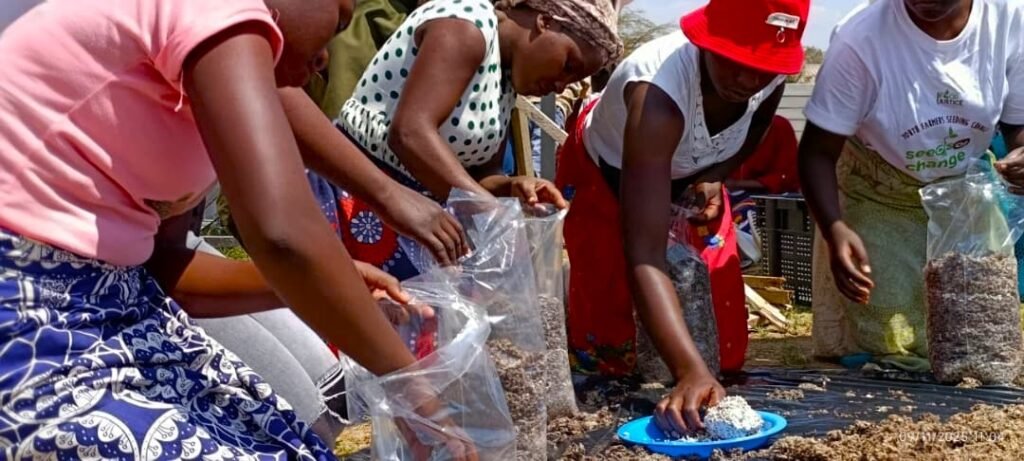
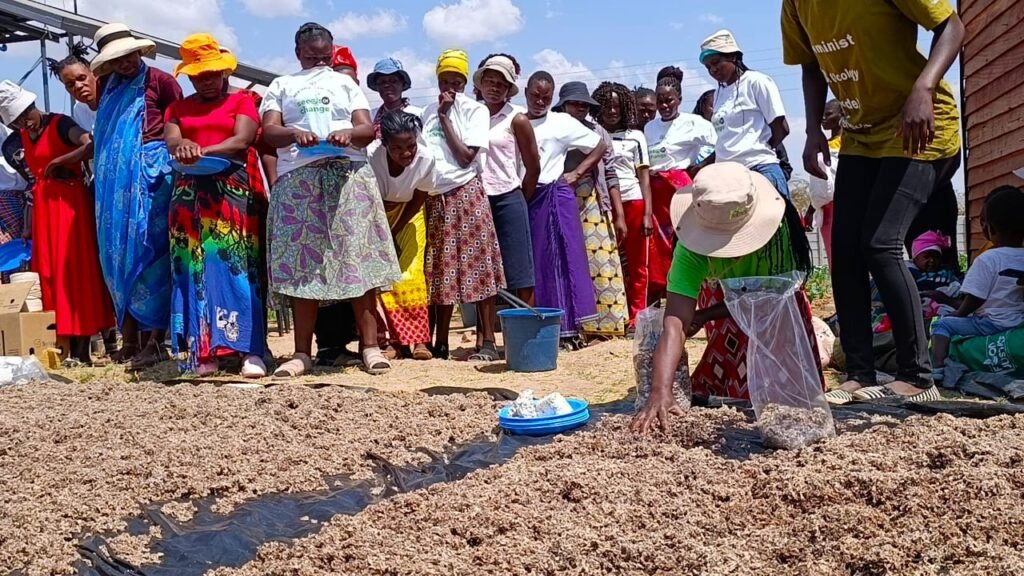
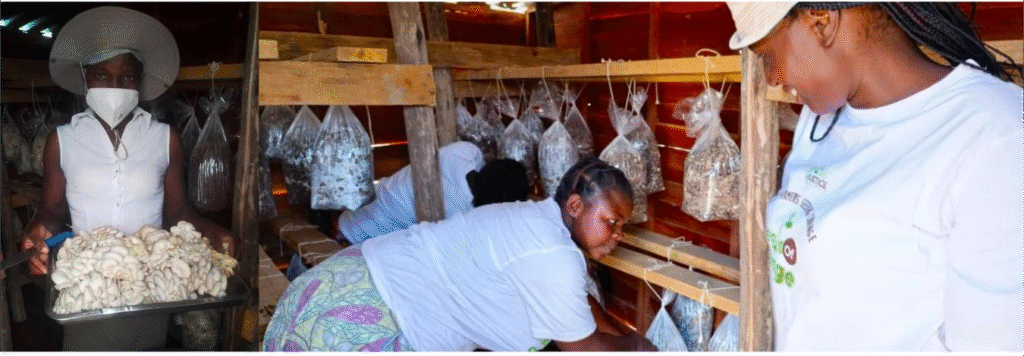
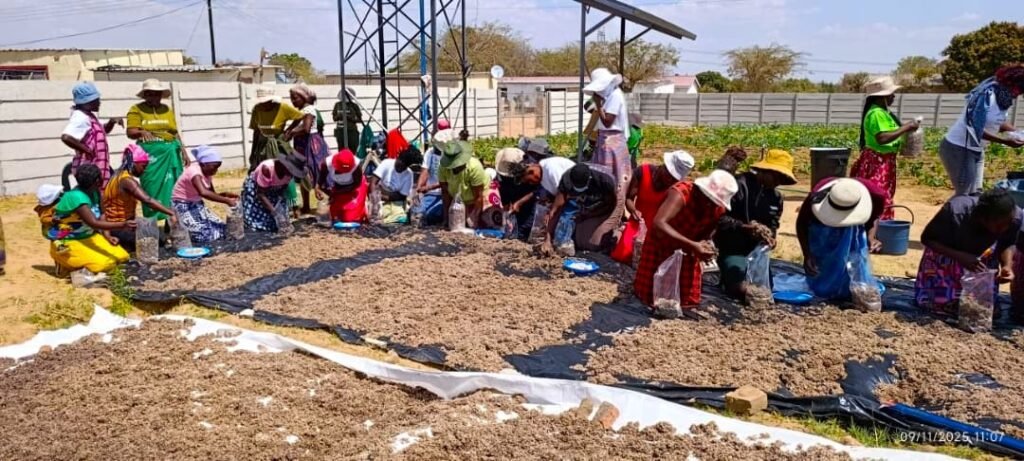
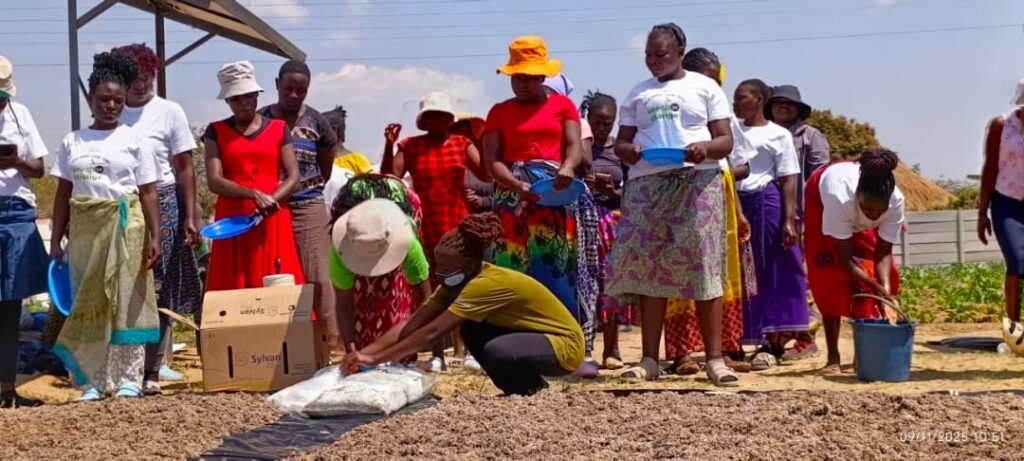
The project’s activities began with community consultations, where participants identified collective livestock and crop enterprises, including vegetables, mushrooms and small livestock. Training sessions followed, introducing the principles of agroecology and hands-on skills such as mushroom cultivation and animal husbandry. In practical workshops, young participants prepared substrates, inoculated mushroom bags and learned production techniques that could generate income.
Enterprise development quickly followed. Members of the youth group began producing oyster mushrooms, generating small but consistent daily earnings.
While modest, these incomes represent more than just economic activity. They are part of a growing green economy, where livelihoods are built around sustainable production, resource efficiency and reduced environmental impact.
Later sessions introduced biofertiliser production and small livestock management, reinforcing efforts to reduce reliance on synthetic inputs while promoting soil health and biodiversity.
As climate variability intensifies across Zimbabwe, development practitioners say small-scale farmers are increasingly turning to low-cost, resilient production methods to protect incomes and food security.
One beneficiary, Brenda Wakuwa, 34, credits the Seeds of Change programme with helping her adapt to shifting weather patterns and rising input costs. The initiative trains participants in climate-resilient agriculture, including farming with reduced fertilizer use and improved water efficiency.
Wakuwa said the training encouraged farmers to maximise available resources rather than rely on expensive external inputs, an approach organisers say is designed to strengthen resilience amid unpredictable rainfall and high input costs.
“The Seeds of Change programme helped me a lot. Climate change is affecting us, so we were trained on how to plan and adapt using the resources we already have. We learned how to farm without fertilizer and use less water. We were also trained in mushroom production so that we could earn a sustainable income,” she said.
Through the programme, she learned mushroom production, a relatively low-water enterprise that can be managed on small plots. She planted her first mushroom crop on 11 September 2025 and harvested it between October and December, generating income within the same season.
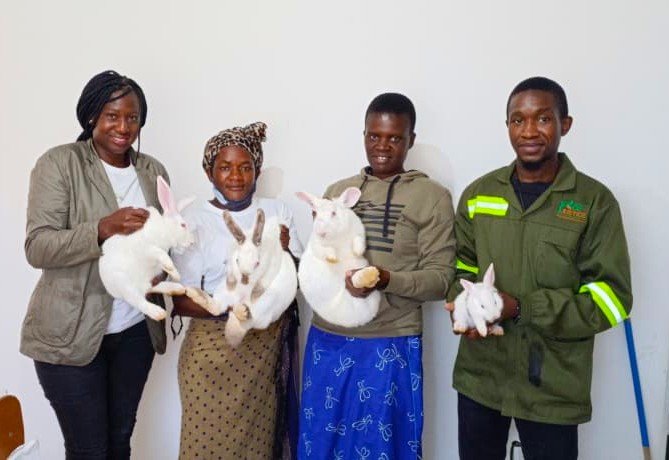
FJN also introduced participants to small livestock production, including rabbit breeding, as a strategy to diversify income sources.
Following the training, the young people received 15 rabbits to start their project. Using proceeds from mushroom sales, they later purchased additional female rabbits to expand their breeding stock.
“We also learned about rabbit breeding. After the training, Food Justice Network provided us with 15 rabbits to start our project, fourteen does and one buck. Later, we were able to buy another seven female rabbits using the money we earned from mushroom production.”
“This programme has helped me greatly as an individual. I learned skills I did not have before, and we are looking forward to expanding into more projects,” she added.
In a context where climate change is already affecting agricultural productivity, such practices offer practical pathways for adaptation. By improving soil fertility, conserving biodiversity and reducing input costs, agroecology provides a buffer against climate shocks while supporting long term climate resilience.
28-year-old Yvonne Mabishe is among rural farmers adapting to climate pressures through low-cost, sustainable livelihoods. Through the Seeds of Change programme, she received training in agroecological practices.
But beyond production, the programme is also influencing household dynamics. Mabishe said her ability to generate income has improved stability at home.
“The programme has brought real change to our lives. It has improved our income and strengthened our household. There is now less conflict at home because my husband knows that even in his absence, we can sustain ourselves through the Seeds of Change initiative,” she said.
But the project’s ambitions extend beyond farming techniques.
Beyond training, the project has deliberately engaged traditional leadership structures to secure local legitimacy. Formal discussions with village authorities helped integrate the initiative into community governance systems, an important step in ensuring sustainability and alignment with local development priorities.
At national level, project representatives participated in platforms such as the National Good Food and Seed Festival and the National Youth Empowerment Symposium in Harare. These platforms connected the group to broader discussions on youth employment, economic inclusion and agricultural policy. They also created opportunities to position agroecology not just as a farming method, but as a climate solution and a source of sustainable, green employment.
The project aligns with government priorities under Zimbabwe’s youth empowerment strategy, particularly around economic participation and education. Organisers say this alignment strengthens the potential for scaling agroecological approaches while contributing to youth inclusion in agriculture.
While the initiative remains community-based, its combination of grassroots production, enterprise development and policy engagement reflects an emerging model that links local action to national food system transformation.
Across Africa, agriculture remains one of the largest employers of young people, yet many positions are informal and vulnerable to economic and environmental shocks. At the same time, the continent faces increasing pressure to create jobs that are both economically viable and environmentally sustainable. Initiatives like Seeds of Change sit at this intersection, demonstrating how agriculture can evolve into a source of green jobs that strengthen climate resilience.
For the young farmers in Zhanje, the transformation is visible in their daily routines, in mushroom houses carefully insulated against light, in small livestock pens, and in community meetings where ideas about food sovereignty, climate adaptation and sustainable livelihoods are discussed alongside practical production plans.
What began as a local response to limited resources is gradually evolving into something larger, a model that connects community agriculture with national development priorities and global climate goals. While the fields remain small, the vision is expanding, from backyard plots to policy conversations, and from survival strategies to long term resilience.
In a country where many young people search for opportunity in an uncertain climate future, these initiatives suggest that farming, when reimagined through agroecology and youth leadership, can become more than a source of food. It can provide green jobs, strengthen resilience to climate change and offer a pathway toward a more sustainable and inclusive economy.
The Seeds of Change project reflects how Africa’s Agenda 2063 is being translated into practice at community level, particularly in the areas of climate adaptation and youth livelihoods. As the African Union’s long-term plan for a prosperous, inclusive and sustainable continent, Agenda 2063 prioritises youth empowerment, green jobs and resilient food systems.
In Zimbabwe, where climate pressures and limited access to resources constrain young farmers, the initiative shows how agroecology can turn these challenges into economic opportunities by enabling low-cost, climate-smart enterprises such as mushroom production and small livestock. At the same time, its push to include young people in policy platforms reflects a core Agenda 2063 goal: ensuring that youth are not just beneficiaries of development, but active drivers of Africa’s transformation.