By Takudzwa Musakasa
A violent hailstorm ripped through Masvingo, tearing roofs from homes and disrupting electricity, water and education. For families now trying to rebuild, the disaster is revealing something harder to measure: people may survive the same storm, but they do not recover from it equally.
MASVINGO – Ratidzo Wekare’s son was studying for his A-Level examinations when the sound above him changed.
The metal roofing sheets over his room began banging violently as the wind gathered strength. Within minutes, the wind was ripping them from the house.
Rain and large hailstones poured through the exposed roof. There was no time to gather his books or move his belongings. He grabbed a blanket, covered his head and moved into the passage, hoping it would offer better protection.
It did not. More of the roof was swept away. Rain, hailstones, leaves and branches blew into the house from different directions.
From inside, the teenager began sending photographs to his mother.
“The hailstones were very big,” Wekare recalled. “They took time to melt.”
By the time the storm subsided, most of their Hillside home had been damaged.
Many of the books her son needed for his examinations were soaked or destroyed.
For Wekare’s family, however, the disaster did not end when the hail stopped falling.
It continued in the darkness that followed.
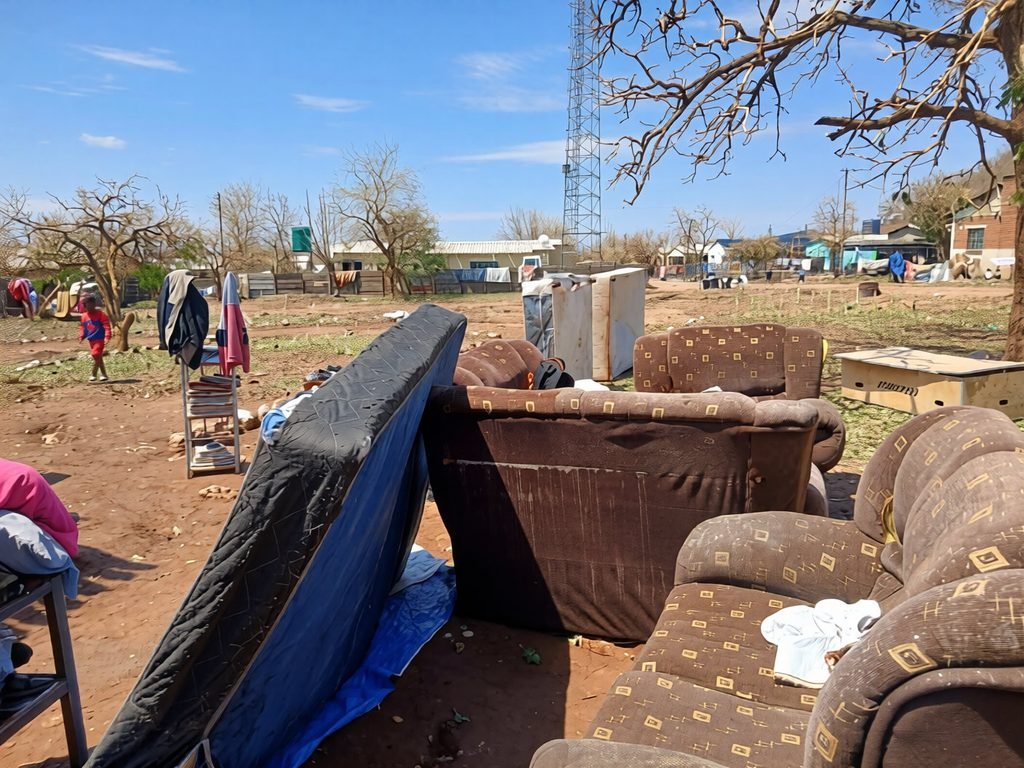
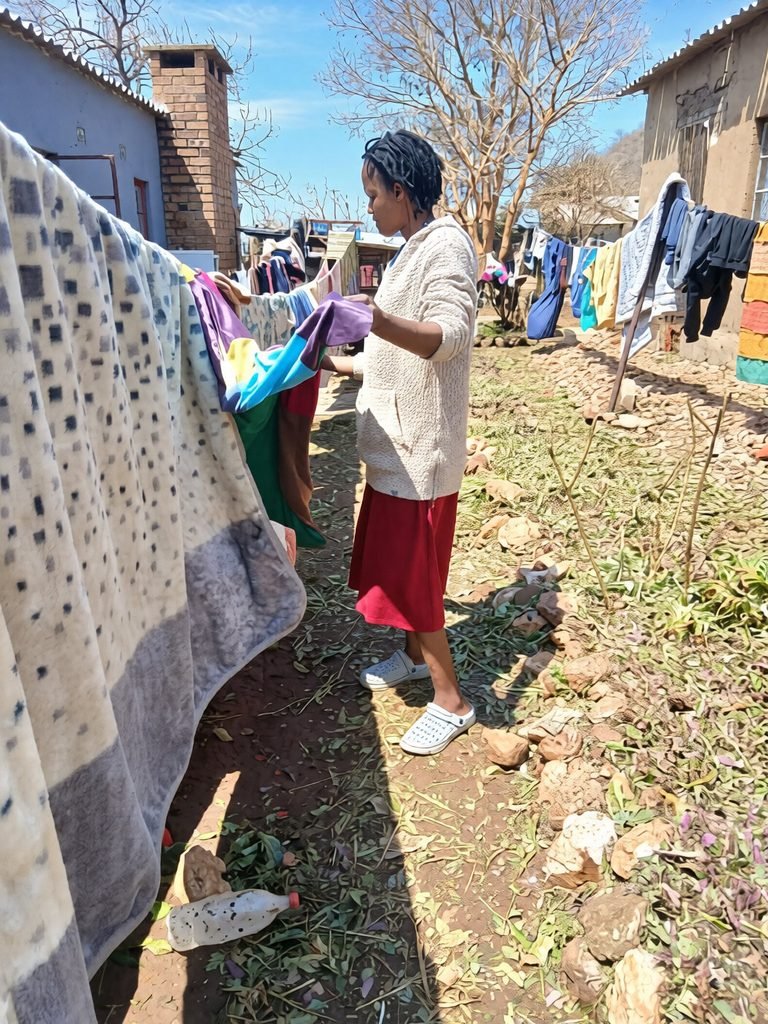

People in Hillside Masvingo Attempting To Dry Out Their Sofas and Blankets
A few minutes, thousands of homes
The severe hailstorm struck Masvingo on the evening of 5 October 2026, damaging homes, vehicles, solar installations and public infrastructure. Masvingo Mayor Aleck Tabe said that night that some families had been left with their homes exposed to the elements. Mucheke and Rujeko halls were subsequently opened as temporary shelters and safe-storage points for household belongings.
The scale became clearer as assessment teams moved through affected communities.
On 6 October, authorities reported that about 13,500 households, an estimated 67,500 people, had been affected. No deaths had been reported at that stage, although assessments were continuing.
By 8 October, the estimate had risen to approximately 17,000 affected households. Government assessments later recorded about 8,500 damaged rooftops, as well as damage to five health centres, five tertiary institutions, 29 schools across Masvingo, Chivi and Gutu, government buildings, electricity installations and other public infrastructure.
The affected areas were declared a State of Disaster under section 27(1) of the Civil Protection Act.
But those figures cannot show what happened inside individual homes.
Nowhere safe to stand
For Henry Chivhanga, the storm began after the electricity disappeared.
Chivhanga, founder and executive director of the Disability Amalgamation Community Trust and a person living with a disability, had decided to sleep for a while and return to his studies when power was restored.
“Little did I know that the rains would become that violent,” he said.
Then the asbestos roofing began coming apart. Window panes shattered. Water entered the rooms. Chivhanga was alone.
He tried to save some of his belongings, including his laptop, but hailstones had already covered the tiled floor.
He slipped. “I fell because it was slippery,” he recalled. “I hit my hip on the floor.”
After that, there was little he could do. “So I had to just stand until the storm subsided.”
When it was over, Chivhanga counted 43 broken window panes and 47 damaged asbestos sheets.
His television had been smashed. His laptop, desktop computer and two printers were damaged. Furniture, clothes and food were soaked.
Among the things destroyed was his medication. “During the storm, I lost even my medication,” he said. “I’m a person with a disability; I take some of my medication.”
Before worrying about computers, furniture or roofing, he first needed to replace his medicine.
“That’s the priority I had to give to myself,” he said. “Let’s work on my medication first, then the other things.”
He was also studying for examinations.
His laptop was gone. Some of the notebooks and material he relied on had been destroyed.
Still, the exams did not disappear simply because his roof had.
“I had to soldier on,” he said.
The storm stopped. The disruption did not.
Across Masvingo, damage to homes was followed by damage to the systems that made ordinary life possible.
An electricity update on 6 October said lines supplying Masvingo Urban and Masvingo District were still out, main substations had faults and all three Mashava-Masvingo lines were down. Around four kilometres of 33kV transmission infrastructure had reportedly collapsed in different sections.
Distribution lines were also affected, while fallen transformers in Mucheke and Rujeko had to be recovered.
A Civil Protection Unit assessment subsequently estimated the damage to ZESA infrastructure at around US$300,000. The power disruption also affected Bushmead Water Works, which depends on electricity to pump water to residents.
Drainage infrastructure and water pipes were also damaged in parts of the city. Government later deployed water bowsers and purification tablets as shortages continued.
Residents interviewed after the storm described carrying bowls and containers to places where water was available and waiting in long queues because nothing was coming from their household taps.
Electricity gradually returned to some areas, but not evenly.
At the time of the interviews for this story, residents said some parts of Hillside and Rujeko had power while other sections remained without electricity.
For families with examination candidates, that uneven recovery mattered.
Studying by candlelight
Wekare’s son depended on electricity for more than lighting.
Like many students, he used electronic devices for studying. The family had also invested in Starlink, partly to support their children’s education.
Without electricity, the system could not operate. Mobile data became an alternative, but an expensive one, particularly when network connectivity was also poor.
“Imagine you had invested in such a system for your child’s education,” Wekare said, “and you don’t have money to buy data because you had paid already.”
She said some people who still had electricity began charging others to power their phones and devices.
There were few options. Her family turned to candles and solar lights. But a light could not replace the books that had been destroyed.
And school itself was not necessarily an escape from the damage. Government assessments recorded damage to 29 schools and five tertiary institutions.
Wekare said some schools had damaged roofs and windows. Teachers, too, were dealing with damage to their own homes.
She was also told that a school block containing Grade Seven pupils’ projects had been affected, leaving some projects soaked or damaged by rain, hail and wind.
“The children writing exams were greatly affected,” she said. “They must have had everything, so that nothing makes them fail to write or fail the exams.”
As of her interview, Wekare said her family had received no relief assistance. They had heard that assistance was coming. They were still waiting.
The storm did not choose. Recovery does.
Chivhanga describes the hailstorm in a way that initially sounds almost like an argument for treating everybody the same.
“The hailstorm was indiscriminate,” he said. “It affected everyone without choosing. It didn’t consider your background or who you are.”
But his experience after the storm led him to a different conclusion.
The storm may not distinguish between people. Recovery does.
On 14 October, Chivhanga said, the Civil Protection Unit gave him 10kg of mealie-meal and 4kg of rice. The Zimbabwe Red Cross provided a six-by-four-metre tent and a bucket.
His children had helped him replace the shattered window panes.
Neighbours had been among the first to respond.
On the night of the storm, they helped him move belongings and cover some items with plastic. One neighbour realised Chivhanga could not cook in his badly damaged house and prepared food for him.
He remains grateful. But he is less certain about what comes next.
Residents were being asked to submit Bills of Quantities detailing damage to their properties. By 13 October, government teams had decentralised assessments to affected wards, with thousands registering for assistance.
For Chivhanga, registering was not the same as knowing whether assistance would come.
“If we could get answers to say who will benefit, when, and what will they benefit, it will help us in our planning,” he said.
The uncertainty affects decisions families have to make immediately.
Should they borrow?
Should they ask relatives for money?
Should they buy roofing material themselves or wait?
“Suppose you ask for help, they give you money to go and buy maybe material, then suddenly you are told, come and collect material from the Civil Protection Unit,” Chivhanga said. “Then it will be like maybe you tried to con your relatives.”
His biggest concern is how vulnerability is identified.
He said that, from his experience of the registration process, persons with disabilities and elderly residents were not initially being separated from everybody else.
“You are just lumped together with everybody else,” he said.
The irony is that government itself has identified people with disabilities and elderly people among those who should receive priority.
By 13 October, authorities said 6,711 vulnerable households were being targeted for food and other assistance, specifically including elderly people, people with disabilities, child-headed households, children and people with chronic illnesses.
For Chivhanga, the question is whether that prioritisation is reflected consistently at the point where residents are assessed.
He does not argue that other people suffered less.
“I appreciate that most of the people suffered the same fate as me,” he said. “But our circumstances are different.”
Then he puts the distinction more simply. “I need an extra mile to go for me to be at an equal basis with others.”
Zimbabwe’s Constitution requires the State, within available resources, to take appropriate measures to enable persons with disabilities to realise their full potential, including access to medical treatment and education.
Article 11 of the UN Convention on the Rights of Persons with Disabilities also requires states to ensure the protection and safety of persons with disabilities during natural disasters and other humanitarian emergencies. United Nations
For Chivhanga, those principles are not abstract.
They are the difference between being counted among thousands of storm victims and having the particular consequences of disability recognised when help arrives.
Who controls the help?
As donations and assistance began moving towards Masvingo, government also moved to centralise their coordination.
On 8 October, Local Government Permanent Secretary Tafadzwa Muguti warned NGOs, development partners and private players against distributing assistance without government direction, according to a statement shared by TellZim News. He said aid should be coordinated at district and provincial level.
There is a practical case for coordination.
With thousands of damaged homes and competing needs for food, tents, water, medicines and construction materials, an organised system can reduce duplication and direct resources towards areas where they are most needed.
Government says its response brings together the public and private sectors, development partners, civil society, local authorities and affected communities.
But greater control over aid also increases the importance of transparency: who is registered, who receives assistance, which vulnerabilities receive priority, and how affected families know what they are entitled to.
For Masvingo, those questions carry history. In 2014, thousands of families were displaced by flooding associated with the Tokwe-Mukosi dam.
Human Rights Watch documented that the then provincial minister ordered donations to be handed to his office for distribution rather than being given directly to survivors. HRW later reported finding humanitarian goods carrying NGO labels being sold in nearby towns and documented complaints of unfair distribution and diversion.
The provincial minister at the time denied that donations had been stolen and said government audits accounted for the aid.
Five years later, following Cyclone Idai, Human Rights Watch documented allegations from survivors that some emergency food was being distributed along political lines. The government disputed the claims, and the Local Government minister subsequently told Parliament that political party activists would not be allowed to distribute disaster aid.
Those previous cases do not establish that current Masvingo relief is being diverted, politicised or distributed unfairly.
The interviews for this story produced no evidence proving that.
But they do explain why clear beneficiary criteria, transparent records and accessible complaints systems matter when survivors are being asked to place their recovery in the hands of a coordinated relief structure.
And sometimes the most urgent accountability question is not about corruption at all.
It is simply: When will help come?
After the hail melts
Disasters lend themselves easily to numbers.
Seventeen thousand affected households.
Thousands of damaged roofs.
Twenty-nine schools.
Five health facilities.
Damaged power lines.
Tonnes of mealie-meal and rice.
But statistics struggle with the smaller things.
A teenager crouching beneath a blanket while his roof is torn away above him.
Books swollen with rainwater days before examinations.
A family that invested in internet for education suddenly buying mobile data it had not budgeted for.
Residents standing in queues with containers because their taps have run dry.
A man slipping on hailstones while trying to save the laptop he needs for his studies.
Medication disappearing beneath water entering through a broken roof.
A neighbour cooking dinner because the person next door no longer has a kitchen he can safely use.
These are also measures of a disaster.
In Hillside, Ratidzo Wekare’s family is trying to rebuild enough normality for an A-Level candidate to continue studying.
There are candles. There are solar lights. There are fewer books.
And there is still the uncertainty of what assistance, if any, will eventually arrive.
For Chivhanga, the list of what needs replacing is long. But when asked what would allow him to start moving forward, he reduces it to the most basic element of a home. A roof.
“Personally, I’m saying if my roof is actually replaced, the other things we can always try to wait for them in the future,” he said, “As long as we are alive.”